
GeoLeaks
REWE Markt (Germany)
Agency: OMD Germany
Award Recognition
- Grand Prix — The Internationalist Awards for Innovative Digital Marketing Solutions 2025
CASE STUDY SUMMARY
For years, digital marketing promised precision.
Advertisers invested billions in geo-targeted media with the expectation that messages were reaching the right people in the right places at the right time.
Few questioned whether that promise was actually true.
REWE did.
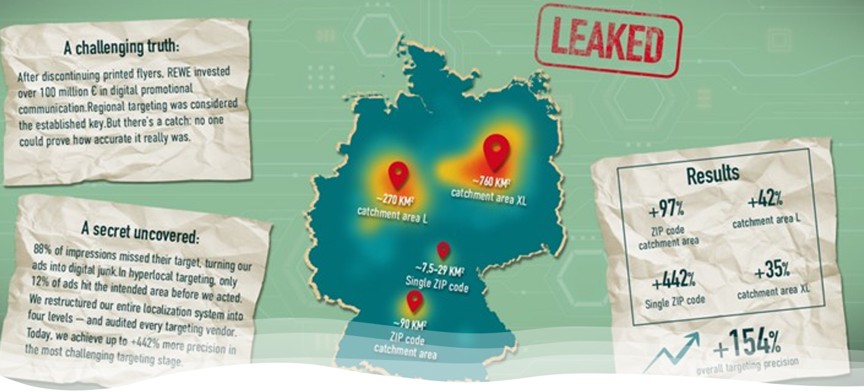
After replacing printed flyers with more than €100 million annually in digital promotional activity, the retailer decided to validate whether geo-targeting was delivering the local relevance it claimed. Using its own logistics and address-level data, REWE conducted a comprehensive audit of digital media delivery. The findings were startling: only 12% of ZIP-code-targeted impressions reached their intended area.
Rather than simply optimizing campaigns, REWE rebuilt its entire localization framework. The company created a new four-tier precision model, audited media partners against real-world delivery data, and established minimum accuracy standards that vendors had to meet to remain in the plan. What emerged was not merely a campaign, but a new system for measuring and validating digital localization.
KEY INSIGHT
Geo-targeting had become an accepted industry practice.
No one had stopped to verify whether it actually worked.
The most important innovation wasn’t targeting more precisely—it was measuring precision in the first place.
WHAT IT REVEALS
Many innovations focus on creating something new.
GeoLeaks demonstrates the power of questioning assumptions.
By auditing a system everyone trusted, REWE exposed a structural flaw affecting an entire industry. The case shows that innovation can come not from adding complexity, but from demanding accountability.
WHAT MADE IT EXCEPTIONAL
Most advertisers optimize within existing systems.
REWE challenged the system itself.
Rather than accepting vendor claims, the company created a measurable framework, established standards, and made localization accountable. In doing so, it transformed geo-targeting from a promise into a performance metric.
KEY RESULTS
• Revealed that only 12% of ZIP-code-targeted impressions reached the intended area
• Increased ZIP-code precision by 442%
• Improved catchment-area accuracy by 97%
• Reduced wasted impressions significantly across the media plan
• Created a scalable precision framework now used across REWE Group businesses, including PENNY and toom
• Established a new benchmark for validating digital localization


